
Pre-Primary Schools in Indore: Building the Foundation for a Bright Future
The early years of a child’s life are filled with curiosity, discovery, and rapid learning. Choosing the right pre-primary school in Indore can therefore be an important decision for parents who want to provide their child with a positive and nurturing start to formal education.
Indore, one of Madhya Pradesh’s major educational and commercial hubs, offers a wide range of preschool and pre-primary education options. From play-based learning centres to schools following structured early-years curricula, parents can find different approaches suited to their child’s needs.
What Is Pre-Primary Education?
Pre-primary education generally refers to the stage before primary school, including programmes such as nursery, playgroup, lower kindergarten (LKG), and upper kindergarten (UKG). The focus at this stage is not simply on teaching children to read and write. Instead, it is about helping them develop essential social, emotional, physical, language, and cognitive skills.
A good pre-primary programme gives children opportunities to:
- Explore and ask questions
- Develop communication skills
- Learn to interact with other children
- Build confidence and independence
- Improve fine and gross motor skills
- Develop early mathematical and language concepts
- Learn through play, stories, music, art, and activities
Why Choose a Pre-Primary School in Indore?
Indore has developed into a prominent education centre, with schools and early-learning institutions offering a variety of educational philosophies and facilities. Parents can explore options in different parts of the city, depending on location, curriculum, teaching approach, and the individual needs of their child.
Many pre-primary schools focus on activity-based and play-based learning, where children learn concepts through hands-on experiences rather than relying only on textbooks. This approach can make learning more engaging while allowing young children to learn at their own pace.
What Should Parents Look for in a Pre-Primary School?
Selecting a preschool involves more than looking at infrastructure or academic results. Since young children spend a significant part of their day at school, the learning environment and interaction with teachers are particularly important.
1. Safe and Child-Friendly Environment
Safety should be one of the first considerations. Parents should look at classroom arrangements, entry and exit procedures, cleanliness, hygiene, and whether the overall environment is designed appropriately for young children.
2. Experienced and Caring Teachers
Teachers play a central role in early childhood education. A supportive teacher can help children feel comfortable, encourage participation, and respond patiently to their individual personalities and learning needs.
3. Play-Based Learning
Young children learn naturally through play. Activities involving blocks, puzzles, drawing, storytelling, music, role-play, and outdoor games can help develop different skills while keeping children engaged.
4. Balanced Curriculum
A strong pre-primary curriculum should provide a balance between early academics and activities that promote creativity, movement, communication, and social development. Children should have opportunities to learn without excessive academic pressure.
5. Clean and Appropriate Facilities
Parents may want to check the classrooms, play areas, washrooms, activity spaces, and other facilities during a school visit. The environment should be clean, accessible, and suitable for young children.
6. Communication with Parents
Regular communication between teachers and parents can help families understand a child’s progress, interests, and areas where additional support may be useful.
Learning Beyond the Classroom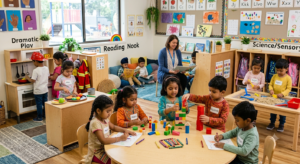
Pre-primary education is not limited to worksheets and classroom lessons. Activities such as nature walks, celebrations, storytelling sessions, art projects, music, dance, and outdoor play can introduce children to new experiences.
These activities can also encourage qualities such as cooperation, creativity, curiosity, and self-expression.
Preparing Children for Primary School
One of the key purposes of pre-primary education is to help children gradually become ready for primary school. This includes developing basic academic concepts as well as practical habits.
Children can learn how to:
- Follow simple instructions
- Participate in group activities
- Organise their belongings
- Communicate their needs
- Complete age-appropriate tasks independently
- Recognise basic numbers, letters, shapes, and patterns
- Develop listening and concentration skills
These foundations can make the transition to primary education more comfortable.
The Role of Parents in Early Education
A child’s education does not stop when the school day ends. Parents can support learning at home by reading stories together, talking with children, encouraging creative activities, playing simple educational games, and giving children opportunities to explore their surroundings.
Most importantly, parents can create a positive attitude towards learning. At this age, encouragement and curiosity are often more valuable than pressure to achieve perfect academic results.
Conclusion
Finding the right pre-primary school in Indore is about finding an environment where children feel safe, valued, curious, and excited to learn. While curriculum and facilities matter, parents should also consider the quality of teacher-child interaction, learning methods, safety, communication, and the overall atmosphere of the school.
The early years provide an important foundation for a child’s future learning journey. With the right combination of supportive teachers, engaging activities, and family involvement, pre-primary education can become a joyful and meaningful first step into the world of learning.