
Absolutely! 😊 Phonics is easiest to teach step by step, especially for young children. The goal is to help the child understand that letters represent sound bend those sounds together to read words.
Teach the sound of a letter rather than only its name.
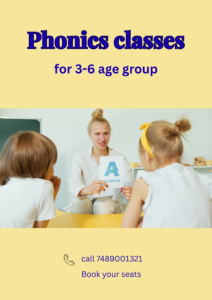
For example:
- m → /m/ as in moon
- s → /s/ as in sun
- t → /t/ as in top
- a → /ă/ as in apple
Don’t teach all 26 letters at once. Start with a small group of useful sounds.
2. Teach blending early
Once the child knows a few sounds, show them how to join them:
m – a – t → mat
Say each sound slowly:
/m/ /ă/ /t/ → mat
Then try:
- sat
- map
- tap
- Sam
Blending is one of the most important phonics skills.
3. Teach sounds using actions and objects
Make it multisensory:
- Show the letter.
- Say the sound.
- Have the child repeat it.
- Trace/write the letter.
- Find objects beginning with that sound.
For /b/, for example: ball, bag, banana.
4. Progress in a sensible order
A useful sequence is:
Stage 1: single-letter sounds
Stage 2: CVC words (cat, dog, sun)
Stage 3: digraphs (sh, ch, th, ck)
Stage 4: consonant blends (st, bl, cr, nd)
Stage 5: long vowels and common vowel patterns (ai, ee, oa, ay)
Stage 6: more complex patterns and tricky/common words
5. Keep lessons short
For a young child, 10–15 minutes every day can be more effective than one long lesson.
A simple lesson could be:
2 minutes: review sounds
3 minutes: introduce one new sound
5 minutes: blend/read words
3 minutes: play a phonics game
2 minutes: read a very simple decodable sentence/book
6. Use games
Children learn phonics much better when it feels like play.
Try:
- Sound hunt: “Find something that starts with /s/.”
- Letter matching: Match letters to pictures.
- Sound bingo
- Build a word: Use magnetic letters to make cat, then chan
- ge c to b → bat.
- Robot talk: Say “/c/ /ă/ /t/” and let the child guess cat.
One important tip
Try not to teach letter names and sounds as if they are the same thing. A child needs to know that “B” is the letter name, while /b/ is the souPhonics classes nd it represents.
If you tell me the child’s age/class (for example, 3–4 years, kindergarten, Grade 1) and whether they are a beginner or already know some letters, I can give you a day-by-day phonics teaching plan with activities and words.